
BesslerWiki archive
MT 41-60
This wiki is preserved in read-only form. Editing and user accounts are no longer available.
MT 041
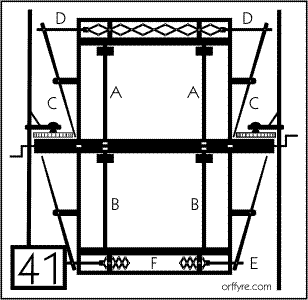
"No. 41: This is yet another stork's-bill model. It is not necessary first to explain the letters. There is only this to mention: the present horizontal application of the stork's bills is always better than the machine with the vertical application, which constantly has more friction. I can assure the reader that there is something special behind the stork's bills. Whoever knows how to construct them will note that the figures sketched here are not exactly the correct artistic application."
- - Johann Bessler
MT 042
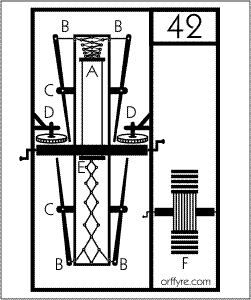
"No. 42: This is another application of the stork's bills. The figure is so clear that I omit explanation of the letters. The side figure F indicates how it would look if one were to multiply the internal structure."
- - Johann Bessler
MT 043

"No. 43: This shows the perpetual stability machine of the well-known Professor Mangold at Rintein. He alleged it to be a motion machine, and he sought to hoax your highness, the landgrave of most blessed memory. However, as a wise prince you soon sent him away and knew that my motion machine was the better one. This figure speaks for itself and requires no explanation; it tells us that it would run readily if only it had feet and legs."
- - Johann Bessler
MT 044
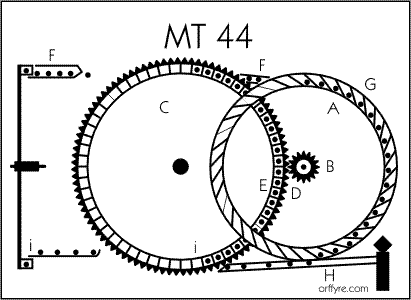
"No. 44: The sphere-method is reintroduced here. The problem shows 2 wheels: A is the main wheel, the axle of which has a gear at B. B drives the somewhat larger wheel C at point D. At side E are spheres which fall out of side G at point H below and into wheel C at point I and then out of C again into A at point F. This problem looks good, but as sketched it does nothing special as long as no other application is present, for the wheel A must revolve several times before C revolves a single time. Thus not enough spheres move from the former into the latter."
- - Johann Bessler
MT 045
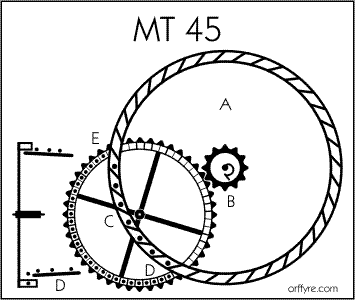
"No. 45: This is the previous invention, except that the one wheel C is much smaller than A. The explanation of the remaining letters C [sic], D and E are indicated by the figure itself."
- - Johann Bessler
MT 046

"No. 46: This special sphere invention has a vertical screw. A is a wheel with sphere which below at B fall out into a channel C and run into the screw at D. The spheres in the screw climb up to E, then out and into wheel A again at F. At G on wheel A is a gear which drives a pole of 2 wheels, one at H and another at I, and the screw-wheel below. The screw-wheel drives a large crane-wheel at K and should pull up a bucket at L; M shows a large perpendicular. Whoever knows about friction can judge this machine."
- - Johann Bessler
MT 047

"No. 47: This is a sphere machine which uses stork's bills. The wheel A carries the spheres. The hook (or curved implement] B reaches down to C and moves the beam of a balance. At D, the two ends of the beam, the stork's bills are pulled so that the spheres are ejected above at E and grasped at F. The two sets of stork's bills are connected to each other over the small wheels at GG. An equilibrium causes the spheres to be ejected at L. At H the spheres fall into the wheel A, and at I they fall out again. Afterwards, at K, the spheres are swallowed and lifted up again. I submit the rest of this machine to the judgment of the wise, who might elucidate the problem."
- - Johann Bessler
MT 048

"No. 48: This is a sphere invention having a paternoster with pockets. A is a wheel. As the pocket-patemoster C raises the spheres, it passes over B, the axle of the wheel. At D the spheres are ejected into a channel. At E the spheres fall into the wheel, and at F they are ejected again into the paternoster. Here, an insufficient number of spheres is carried to the wheel A by means of the paternoster. The principle is good, but this figure will bring about no mobility by itself until completely different, additional structures have been provided."
- - Johann Bessler
MT 049

"No. 49: This is the previous model except that the pocket-patemoster is taller and larger. A is a large wheel. B, the axle of the wheel, moves by means of a chain which reaches up to the paternoster at C. At C the spheres are ejected into the large wheel. Below, at D, they fall off the wheel and are swallowed into the paternoster. The figure makes the thing utterly intelligible, and an average intelligence can grasp the effect of this machine."
- - Johann Bessler
MT 050
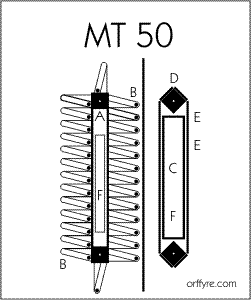
"No. 50: This is a special pocket-paternoster. A is the upper axle. BB are the hollows with spheres. C is an internal piece which prevents the paternoster from collapsing on itself. At D above and below this paternoster passes over the axles. On the right side E the spheres run out, and on the other side, they run in. For the mobilists who believe in this model, I note: side E is heavier and one would suppose that it would inevitably cause operation, but the thing remains in status quo.
"
- - Johann Bessler
MT 051
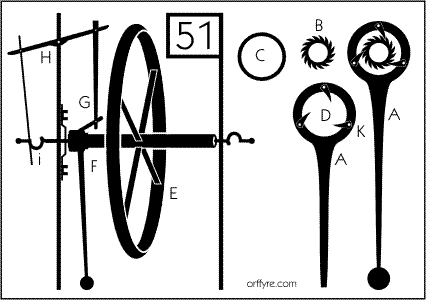
"No. 51: This is a perpendicular invention which is meant to maintain motion by means of oscillation. A is a perpendicular with stoppers, or stop-cones, at the top which catch in a small wheel B. A fastens onto the wheel E. D show the perpendicular per se with stop-cones. H is a horizontal perpendicular, or beam of a balance. H moves by means of the curved implement I on the one side and the perpendicular F at G on the other side. Motion by means of the oscillation of H is expected, but the invention is wisely criticized. "
- - Johann Bessler
MT 052
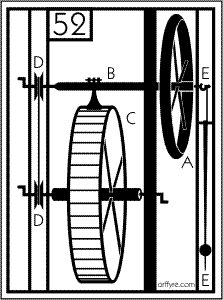
"No. 52: The present invention or speculation is to be found at the place of an eminent man. I was not a little surprised at the imagination involved in it. A is a balance wheel, and B is its axle. Clappers, or mallets, on B strike the wheel C, which should thereby move. At D are wheels which, by means of a cord, should move the upper axle B and set a perpendicular going at E. I will only say the following: no wheel is moved through strong blows, for paddles would sooner dash it into 1000 pieces, and it would be utterly destroyed with bullets, as is sufficiently known."
- - Johann Bessler
MT 053
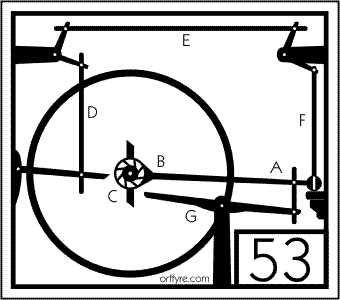
"No. 53: This is a perpendicular model. A is a lever with a weight. At B the lever has stop-cones which should move the axle at C by means of a small wheel with 2 arms. The arms should raise the pole D by means of the lath. D should move a Winkelhaken ["angle-hook"] above, and this angle-hook should move another angle-hook by means of pole E. This latter angle-hook should move the pole F which should raise the main lever A. G is a beam of a balance and should accomplish all the raising. I saw this fantasy along with many other such devices recorded in a machine book at the home of a learned friend, but I did not see the effect."
- - Johann Bessler
MT 054
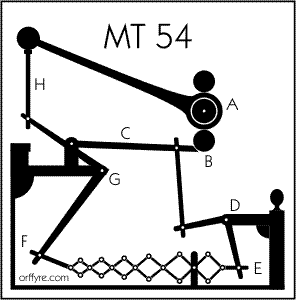
"No. 54: This is simply a demonstration of how one might raise the large lever of the previous model by means of stork's bills. The letters are self-explanatory."
- - Johann Bessler
MT 055
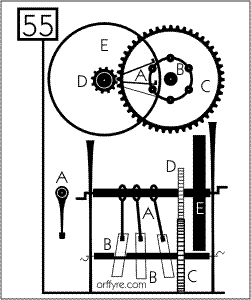
MT 056
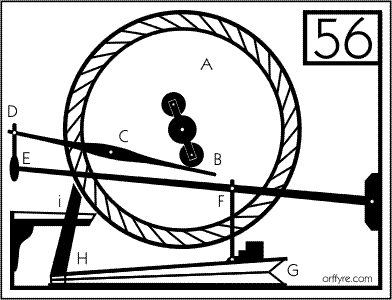
"No. 56: pair of bellows"
- - Johann Bessler
MT 057
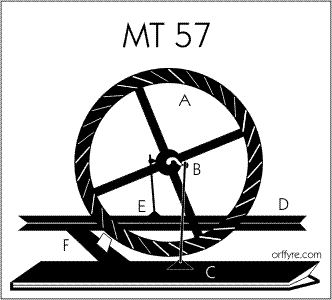
MT 058
MT 059
MT 060

41 - 60